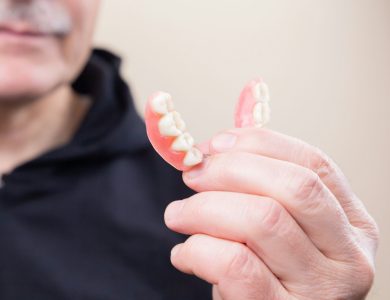
What to Do Right Now When Your Denture Falls Out
When your denture pops out, take it out completely and look it over before doing anything else. A slipped denture almost never signals an emergency, and rushing to jam it back into place is how cracks turn into clean breaks.
Inspect it. Hold the denture up to good light and check for hairline cracks, a chipped tooth, or a worn-down pink lining. Run a finger along the edges. If you see a crack or a piece is missing, stop — forcing a damaged denture back in can cut your gums or snap it further. Set it aside and plan to call a dentist.
Clean and dry both surfaces. Rinse the denture under cool (never hot) water, and wipe your gums and the roof of your mouth. Saliva, food debris, and old adhesive all break the seal holding a denture in place.
Reseat it correctly. For an upper denture, position it and press up with steady thumb pressure to create the suction that keeps it anchored. For a lower denture, settle it straight down onto the ridge — lowers rely on fit, not suction.
When to leave it out. If it won’t seat without rocking, hurts, or is visibly damaged, leave it out tonight. The American College of Prosthodontists notes gum tissue needs rest anyway, and sleeping without it for one night won’t hurt you.
Using Denture Adhesive as a Temporary Fix Tonight
Here’s the thing about adhesive: more is not better. The single biggest mistake people make when their denture starts slipping is loading it up like frosting on a cake, which makes the fit worse and oozes out around the edges. Apply it in thin strips or small dots — a few pea-sized dabs across the ridge of the denture, kept away from the very edges — then press and hold for 10 to 15 seconds on dry, clean gums.
As for which type to grab tonight, here’s the quick breakdown:
- Cream — the strongest hold and best for a denture that’s started slipping; spread thin, not thick.
- Powder — lighter, less messy, easy to clean off, but a weaker grip for a loose fit.
- Strips/pads — pre-cut and tidy, good for travel, but the least adjustable.
A tube of cream runs roughly $5–$12 at most US drugstores, per Consumer Reports’ pricing surveys — an easy bridge to get you through dinner or a meeting.
But understand what adhesive can’t do: it cannot fix a denture that no longer fits your gums. If you’re reapplying more than once or twice a day, using thicker amounts than the package directs, or your denture still wobbles despite a fresh application, you’re masking a fit problem that needs a reline or replacement — not more glue.
Foods and Habits to Avoid While Your Denture Is Loose
Adhesive buys you time, but the wrong meal can undo it. Once a denture starts slipping, a few smart adjustments keep it seated and your confidence intact until you get it relined or replaced.
The foods to skip: Sticky and chewy items are the worst offenders because they grip the denture and lift it right off your gums.
- Sticky: caramel, taffy, gummy candy, fresh white bread, peanut butter
- Hard: nuts, hard candy, ice, raw carrots, apples bitten directly
- Chewy: tough steak, bagels, dried fruit, crusty rolls
How you chew matters too. Cut food into smaller pieces and chew on both sides at once. Loading one side creates a seesaw effect that tips the denture loose. Slower, balanced bites distribute pressure and keep the seal stable.
Talking and laughing: If you feel a slip coming, gently bite down and swallow to reseat it. Keeping a small tube of adhesive on hand lets you re-secure it discreetly in a restroom.
None of this fixes the underlying problem. A worn lining or shrinking ridge won’t improve with diet alone, but these habits get you through the next week or two until a dentist can address the real cause.
Why Your Denture Keeps Falling Out: Common Causes
Here’s what most people don’t realize: a denture that suddenly won’t stay put usually isn’t broken in any obvious way — the problem is often invisible, and it’s split between two culprits. Either the denture itself has worn out, or your mouth has quietly changed shape underneath it. Figuring out which one you’re dealing with is the difference between a $40 fix and a much bigger conversation.
When the Denture Itself Is the Problem
Dentures take a beating. The lining that grips your gums wears thin, the acrylic base can warp from heat (a cup of hot coffee soaking, or accidental near-boiling water), and hairline cracks weaken the whole structure. A damaged or worn base can’t form a proper seal anymore, so it slips. If your dentures are under five years old and were fitting fine until recently, the appliance is the likely suspect.
When Your Mouth Has Changed
This one surprises people. After you lose teeth, the jawbone underneath slowly shrinks — a process called bone resorption — and your gums recede along with it. The American College of Prosthodontists notes bone loss continues for years after extractions, so a denture molded to your mouth five or ten years ago is now fitting an entirely different shape.
One more factor: dry mouth. Saliva creates the suction that holds an upper denture in place. Medications, aging, and dehydration all reduce saliva, weakening that seal even when everything else is fine.
How Long You’ve Had Your Dentures Tells You the Likely Fix
That changing fit follows a predictable timeline, which is why the age of your dentures usually predicts what kind of fix you’re looking at. So the question isn’t only “what’s wrong,” it’s “how long have these been in my mouth?”
Under 1 year: likely a quick adjustment
If your dentures are newer than a year and suddenly slipping, this is rarely a replacement situation. It’s usually a minor fit adjustment or a small reline as your gums finish healing from extractions. Many dentists handle this in a single visit, sometimes at little or no charge if it’s still within the adjustment window of your original fitting.
2–5 years: a reline is common
By this point, your gums have settled and the gap between denture and gum has grown. A reline — adding new material to the inside surface — restores the snug fit. Expect roughly $200–$500 depending on whether it’s done chairside or sent to a lab.
5–7+ years: replacement may be due
Consumer Reports notes dentures generally need replacing every five to seven years. Past that, the teeth wear down and the fit drifts too far for a reline. Plan for a full $1,000–$3,000 per-arch replacement.
Reline, Repair, or Replacement: How to Choose
Here’s the good news: most denture problems don’t require starting from scratch. The trick is matching what’s actually wrong to the cheapest fix that solves it — and not getting talked into a $4,000 implant set when a $200 reline would do.
A reline resurfaces the inside of your denture so it hugs your gums again. Your jawbone and gums shrink slowly over the years, leaving the old fit loose even though the denture itself is fine. A soft or hard reline typically runs $200–$500 per arch, and it’s usually enough when the teeth look good but the grip has gone.
A repair handles cracks, breaks, or a popped-out tooth — a mechanical failure, not a fit problem. Expect roughly $100–$300, often same-day for simple breaks.
Replacement makes sense when the denture is worn out, repeatedly breaking, or so loose that relines stop holding. Full new dentures generally run $1,000–$3,000 per arch; implant-supported dentures, which anchor to the jaw and rarely slip, run $5,000–$25,000 depending on how many implants. Consumer Reports notes prices vary widely by region, so get more than one quote.
Quick decision frame
- Loose fit, denture under 5–7 years old: reline.
- Crack or broken tooth, otherwise good fit: repair.
- Worn, brittle, or 7+ years old: replacement — and ask about implants for value.
Red Flags That Mean You Should See a Dentist Soon
Some slipping dentures are an annoyance you can manage with adhesive and a soft-food day. Others are your mouth waving a small red flag, and ignoring them tends to make both the discomfort and the eventual bill worse. Here’s how to tell the difference.
Call your dentist within a few days if you notice any of these:
- Sore spots, ulcers, or bleeding gums. A denture that rubs in one place creates raw patches that can turn into open sores. Left alone, these can get infected, and a sore that won’t heal after two weeks deserves a professional look.
- Cracks, chips, or a clean break. Drugstore repair kits exist, but a cracked denture rarely fits the way it should afterward, and a botched glue job can cut your gums. Let a dentist or lab handle it.
- Looseness that adhesive won’t fix. If you’ve repositioned it, applied adhesive correctly, and it still floats or pops out, the underlying fit has changed. That usually means a reline, often running $200–$500 per arch.
- Pain, swelling, or trouble eating. Persistent pain or facial swelling isn’t normal wear and tear. Consumer Reports notes untreated mouth irritation can mask bigger issues, so escalate these promptly rather than waiting it out.
What a Dentist Visit Involves and What It Will Cost
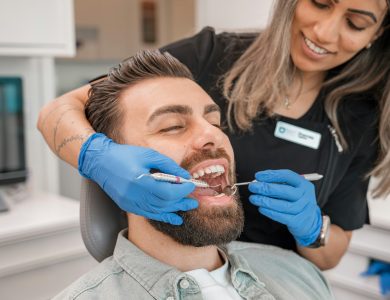
Here’s the part most people dread, and it’s usually less than they fear. When you walk in, the dentist starts with an assessment: they’ll check how the denture sits, look at your gums and bone, and figure out whether the problem is the appliance or the mouth underneath it. From there, the fix follows the cause.
A simple adjustment, where they grind down a sore spot or tweak the fit, often runs $50–$150. A reline, where new material is added to the inside to match your changed gums, typically costs $200–$500 per arch. A crack or broken tooth repair lands around $100–$300. A full replacement denture is the big one — generally $1,000–$3,000 per arch, more if you go premium.
Insurance can soften the blow. Many dental plans cover relines and repairs at 50%, and Medicare Advantage plans increasingly include some denture benefits, though traditional Medicare does not. According to Consumer Reports, dental discount plans can also trim 20–40% off out-of-pocket costs if you lack coverage.
The reassuring truth: the vast majority of slipping dentures are fixable, and many need only a reline rather than a full redo. To keep it from recurring, schedule a checkup every year or two — your gums keep changing, and catching the shift early means a cheap adjustment instead of an expensive surprise.